Inside the FlexBeam Study: Energy Efficiency, Mitochondria, and Fatigue


Perceived fatigue is subjective which means it's a person’s own feeling of their energy levels. However, being subjective doesn’t mean it’s not valid. Fatigue is very real, and for many people it’s the thing that limits them the most and affects their quality of life.
This feeling is usually seen as a lack of energy. If you’re exhausted, the assumption is that your body simply isn’t producing enough of it. However, very often, it’s not about how much energy you have, but how well your body is using it. Inefficient use of energy can mean that some of it is lost, not enough gets into important reserves, and your body might operate in the emergency mode more frequently than necessary.
The difference between lack of energy and lack of optimal use of energy matters. A lot. If fatigue isn’t caused by low energy, then approaches focused only on increasing it miss the point.
This study was built around that distinction. Instead of asking whether FlexBeam could make the mitochondria generate more energy, it looked at something more important: how energy is handled at the cellular level, and whether changes there line up with how people actually feel.
Why We Ran This Study
Fatigue is difficult to study properly. Part of the reason for this is that it depends both on biology and experience. Blood markers can change without people feeling better. At the same time, people can report improvements without markers showing up better.
Most tools and interventions are based on blood tests or personal reports. Either they rely on how people say they feel, or they focus on biological markers without asking how this reflects on a person’s quality of life. Both approaches leave gaps.
We wanted to look at both at the same time.
This study was designed to examine whether changes in the way the body processes cellular energy could be measured in the blood and whether those changes corresponded to the perceived fatigue. In other words, if energy use at the cellular level improves, does that mean a person is feeling more energized and less fatigued?
To inspect this, we included two very different groups:
- People dealing with persistent fatigue or low energy.
- Performance-adapted athletes under regular, structured training load.
The goal wasn’t to compare performance or outcomes between them, but to understand whether baseline physiology influences how the same intervention is reflected in the body.
That context matters. If the same device produces different but logical patterns of change depending on the starting point, it strengthens the case that the effects are biological, not incidental.
Measuring Fatigue? Challenge and Solution
There is no single test that captures fatigue as it is not one isolated problem. It is a result of the ways the body produces, manages, and adapts its energy.
Energy is produced by mitochondria which makes mitochondrial function the most direct way to understand fatigue. However, measuring the quality of mitochondrial function has been a challenge. They were mainly focused on counting mitochondria rather than measuring how well they work. Moreover, these tests were either invasive muscle biopsies, or indirect tests, that are complex, expensive, without giving relevant results.
What we used is a new, patented, scientifically validated method that avoids these limitations. It requires only a simple finger-prick blood sample. Living cells from this sample are exposed to controlled stress in the lab, allowing direct assessment of how well mitochondria produce energy, how much reserve they have, and how they respond to demand.
FlexBeam Study: Design and Population
This was a 30-day observational pilot study with a total of 20 participants assigned to one of these groups:
- Chronic fatigue cohort
- Athletic cohort
The reason for having these two cohorts was to get information from people with different baseline physiological states.
FlexBeam was used at home for 30 days, six days per week, with one rest day per week. Each session consisted of four sequential 10-minute placements, according to recommendations from the manufacturer.
Assessment Timepoints
Measurements were collected at three points during the study.
- Day 0 (baseline)
- Day 15 (midpoint)
- Day 30 (endpoint)
At each of these timepoints, we looked at two things side by side: how participants reported feeling, and what was happening at the cellular level in their blood.
How Fatigue Was Measured
Perceived fatigue was assessed using validated questionnaire tools appropriate to each cohort.
Different questionnaires were used intentionally, as chronic fatigue and exercise-related fatigue represent distinct physiological states Questionnaire results were analyzed as total fatigue scores and used to evaluate changes in perceived fatigue over time.
How Mitochondrial Function Was Measured
Mitochondrial bioenergetics were assessed using the meScreen™ mitochondrial assay, a validated and patented bioassay designed to evaluate cellular energy metabolism.
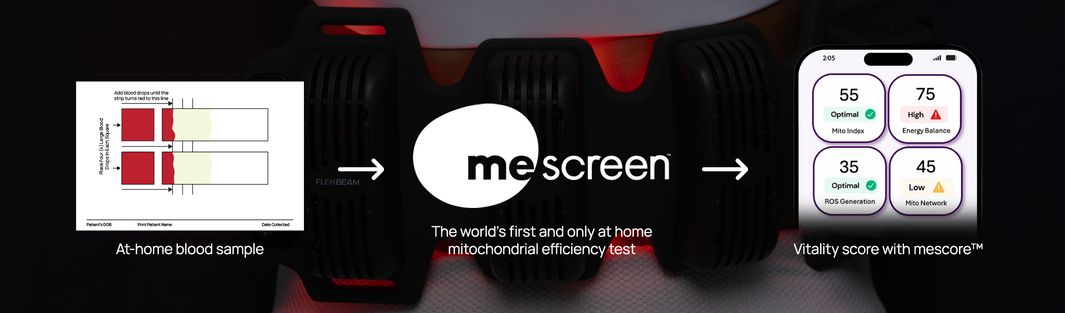
At each timepoint, participants provided a small finger-prick blood sample. No venous blood draw, fasting, or special preparation was required. The samples contained living cells, which were analyzed under controlled laboratory conditions for mitochondria energy production, potential, aerobic score and oxidative stress.
Why oxidative stress mattered in this study
Reactive oxygen species (ROS) are often thought of as the “exhaust” of energy production. The faster the engine runs, the more exhaust it produces. Because of that, there’s a common assumption in physiology that anything designed to improve mitochondrial activity must also increase oxidative stress.
That’s not necessarily true. Improving how efficiently cells use energy is very different from forcing them to produce more of it. This is why ROS was included as a key marker in this study. Measuring oxidative stress alongside energy-related parameters allowed us to see whether changes reflected healthier energy efficiency—or unwanted cellular strain.
The Key Insight: the Same Device, Different Biology
All participants followed the same FlexBeam protocol with the same schedule and duration. The only thing that was different was the biology people started with.
- Participants dealing with persistent fatigue entered the study with cells being overworked and their energy reserves low.
- Athletes, on the other hand, had a better starting point, due to regular training and adaptation.
Because of that, the patterns of change over the 30 days looked different between the two groups. Not contradictory. Different in a way that made sense.
- In the fatigue group, the most meaningful changes were in terms of recovery and restoration. They showed moving away from constant strain and toward building healthier energy reserves.
- In athletes, the changes reflected more optimization with cells becoming more efficient without increasing overall energy.
This distinction is important. It suggests that the FlexBeam effects weren’t generalized, but tailored to each groups’ needs. That context is essential for interpreting the results.
What Changed in People With Fatigue or Low Energy
The primary changes that participants dealing with persistent fatigue reported (and showed on tests) included recovery at the cellular level, with improvements in energy reserve, efficiency, and resilience.
- 15–30% increase in mitochondrial energy reserve capacity: Cells gained back stored energy, meaning they were no longer operating near exhaustion and had more buffer to handle daily stress.
- 10–20% improvement in mitochondrial efficiency: Mitochondria wasted less energy just to function, allowing more usable energy from the same inputs..
- 10–20% reduction in reliance on inefficient “backup” energy pathways: Cells shifted away from emergency glycolytic energy toward healthier mitochondrial metabolism.
- No increase in oxidative stress or cellular instability: Improvements occurred without increased cell damage or metabolic strain.
Cells produced energy more cleanly, kept more in reserve, and crashed less easily, matching the ~37% reduction in reported fatigue seen in questionnaires.
What Changed in Athletes
After 30 days of using FlexBeam, athletes didn’t show increased energy production. Their cells simply worked smarter. Near-infrared and red light therapy acted as a muscle recovery tool and helped sustained performance under training load.
- 10–20% reduction in mitochondrial energy waste: Mitochondria became more efficient, producing the same output with less unnecessary energy loss.
- 15–25% lower reliance on glycolytic (“emergency”) energy systems: Cells relied less on inefficient, fatigue-producing pathways and more on aerobic mitochondrial energy.
- Stable total energy output with improved efficiency: Energy production was not artificially increased. Instead, it became cleaner and more economical.
- No increase in oxidative stress or suppressed stress response: Adaptations supported performance and recovery without blunting training adaptation.
What Didn’t Happen and Why That Matters
Alongside the observed improvements in energy handling, the study did not show biological signals that would suggest overstimulation, cellular stress, or forced energy production.
- No increase in oxidative stress (ROS): Energy-related improvements occurred without elevated markers of oxidative damage at rest or under stress.
- No signs of mitochondrial network instability: The structure and coordination of mitochondrial networks remained stable throughout the study.
- No forced increase in total energy output: Changes reflected improved efficiency and reserve rather than pushing cells to produce more energy.
- No suppression of normal stress responses in athletes: Adaptations supported recovery without blunting physiological responses to training load.
The absence of these signals is important. It suggests that the observed changes reflect healthier energy regulation rather than short-term stimulation, and supports the interpretation that FlexBeam use was associated with biologically appropriate adaptation rather than metabolic strain.
What mitochondrial network stability tells us
Mitochondria do not function in isolation. Inside each cell, they form a dynamic network that constantly reorganizes to meet energy demands. When this network becomes unstable or fragmented, it is a sign that cells are under stress and struggling to maintain energy balance. That is a pattern commonly seen in chronic fatigue, overtraining, and metabolic dysfunction.
The 15-Day Timepoint Effect
When the data were reviewed over time, a clear pattern showed up: most of the meaningful changes appeared early, by the 15th day of the study. From that point on, the effects stabilized. That tells us how the body was responding.
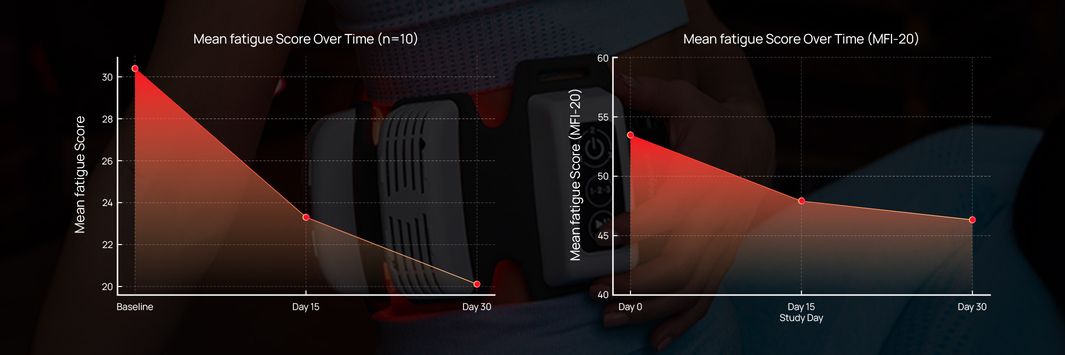
In practical terms:
- Early changes (by Day 15) suggest a functional shift: cells started handling energy differently relatively quickly.
- Later changes (Day 15 to Day 30) were smaller and more stabilizing, not acceleration.
This matters because mitochondrial adaptation usually works that way. Initially, systems become more efficient or regain reserve, and then, those changes set and stabilize.
The 15-day timepoint showed the true value of FlexBeam effects and proved that this is not a simple energy production stimulation. If it were the stimulation, the study would show constantly increased output with rising stress markers.
That’s not what happened.
So “Day 15 mattered” because it supports the interpretation that the changes reflect adaptation, not overstimulation or forced energy production.
Why This Matters Beyond the Study of FlexBeam
Fatigue is often treated as a problem of not having enough energy. This study suggests a different way of looking at it. In both groups, the most consistent changes were not about producing more energy, but about using energy more effectively and maintaining reserve.
That difference is all that matters in daily life. Energy efficiency influences how resilient the body feels, how quickly it recovers, and how easily it deals with strain.
By looking at perceived fatigue together with measurable changes in cellular energy handling, this study offers a clearer framework for understanding fatigue and recovery. Not as a question of pushing the system harder, but of supporting how it functions under demand.
Study scope and next steps
This was a small, exploratory pilot study designed to examine biological patterns rather than to establish definitive effect sizes. While the results were internally consistent across two distinct populations, the sample size limits broad generalization. These findings support the need for larger studies with more homogeneous groups, such as athletes under similar training loads or individuals with comparable fatigue profile.
This study reflects how FlexBeam is intended to be used: consistently, at home, and in support of the body’s existing energy systems. While fatigue and recovery were the focus here, the same mechanisms are relevant to other areas FlexBeam is designed to support, including pain relief, sleep quality, athletic performance, and everyday recovery under physical strain. If you’re curious how this approach might work for you, FlexBeam can be tried at home, risk-free.
"These findings are exploratory and support further controlled trials."
Read the abstract here: Wearable Photobiomodulation and Mitochondrial Bioenergetics