Struggling with neck pain? Here’s what you should know


Neck pain is extremely common. Many people experience it after long days in front of a screen, periods of high stress, intense exercise, or simply sleeping in an awkward position. For some, the pain goes away quickly. For others, stiffness and discomfort can become a recurring problem.
The neck is both strong and highly mobile, but it’s under some degree of strain throughout much of the day. It supports the head, helps the shoulders move, and relies on small muscles and joints that are constantly working as we sit, walk, exercise, and use our phones or computers.
In this guide, we’ll look at common causes of neck pain, symptoms to pay attention to, what you can do yourself, and when it makes sense to see a doctor or other healthcare professional. We’ll also cover some simple exercises and explore how red light therapy can be used alongside movement and other approaches.
At Recharge Health, we focus on pain relief and recovery, and our educational resources are developed and reviewed in collaboration with our clinical team, led by co-founder and Clinical Director Dr. Zulia Frost.
What are the most common causes of neck pain?
The most common causes of neck pain include muscle tension, prolonged static positions, stress, and temporary loss of mobility. Neck pain can also develop after exercise, sleep, or movements that put more strain on the neck than it’s used to.
In some cases, neck pain may be related to nerve irritation or changes in the structures of the neck that should be evaluated by a healthcare professional.
| Cause/condition | Typical signs | What to try first |
|---|---|---|
| Muscle tension and stress-related neck pain | Soreness, tightness, and stiffness in the neck and shoulders. Often worse after stress or prolonged periods in the same position | Movement, short breaks, relaxation, and varying your working position |
| Prolonged sitting and screen use | A stiff or painful neck after spending hours in front of a screen or in the same position | Take regular breaks and alternate between sitting, standing, and moving around |
| Reduced mobility and stiffness | Difficulty turning your head, looking up, or moving your neck freely without discomfort | Gentle activity and gradual movement within a comfortable range |
| Nerve irritation | Pain that radiates from the neck into the shoulder or arm, sometimes with tingling or numbness | Avoid movements that worsen symptoms. See a healthcare professional if radiating pain persists or you experience significant numbness or weakness |
| Herniated disc, arthritis, or injury | May cause persistent or more pronounced neck pain, although symptoms can vary | Seek professional evaluation if the pain is severe, unusual, or doesn’t improve |
Muscle tension and stress-related neck pain
Tight, tense muscles are a common cause of neck pain.
When the muscles around the neck and shoulders stay in the same position for long periods, they can become sore, tired, and stiff. This can happen after spending hours at a computer, driving, or frequently looking down at your phone.
Stress can make the problem more noticeable because many people unconsciously tense their shoulders and the muscles around their neck when they’re stressed.
Experiencing muscle pain? Read our guide to common causes and treatments that may help relieve the pain.
Prolonged sitting and screen use
You don’t necessarily need to have poor posture to develop neck pain. The problem may simply be that you’re staying in the same position for too long.
Even good posture can become uncomfortable if your body doesn’t get a chance to move.
Taking regular breaks and alternating between sitting, standing, and moving can therefore be just as important as trying to find one “perfect” working position.
Reduced mobility and stiffness
For some people, the main issue is stiffness. It may be difficult to turn your head to the side, look up, or move your neck freely without discomfort.
This type of stiffness can develop after sleep, physical activity, or long periods with little movement. Gentle activity and gradually moving the neck through a comfortable range can often help, provided there isn’t an injury or another medical condition that requires treatment.
Neck pain that radiates into the arm
Pain that travels from the neck into the shoulder or arm can sometimes be caused by irritation or compression of a nerve.
You may also experience tingling, numbness, or changes in sensation in your arm or hand.
These symptoms don’t automatically mean something serious is wrong. However, if radiating pain persists or you experience significant numbness or weakness, you should have it evaluated by a healthcare professional.
Other causes
In some cases, neck pain may be associated with a herniated disc, arthritis, injury, or other conditions.
Symptoms alone aren’t enough to determine the cause. If your pain is severe, persistent, or unusual, avoid trying to diagnose it yourself and seek advice from a qualified healthcare professional.
Common symptoms
Neck pain can feel very different from person to person. Some people experience a constant ache, while others mainly notice stiffness when moving their head.
Common symptoms include:
- Neck stiffness
- Sore or tender muscles
- Reduced range of motion
- Pain with certain movements
- Tension in the shoulders
- Headaches
- Pain that spreads toward the shoulder or arm
Where you feel the pain can sometimes provide clues about which structures may be irritated, but location alone isn’t enough to make a diagnosis.
Neck pain and headaches
It’s possible to experience neck pain and headaches at the same time.
For some people, tension and pain in the neck can be associated with headaches. The pain may be felt at the back of the head or seem to travel upward from the neck.
If you suddenly develop a very severe or unusual headache alongside neck pain, or experience other neurological symptoms at the same time, seek medical attention.
Neck pain and throat pain
Neck and throat pain can have several different causes. Muscle tension can cause discomfort around the neck, jaw, and throat area, but a sore or painful throat can also have completely unrelated causes.
If you also have a fever, significant difficulty swallowing, trouble breathing, or severe neck stiffness, contact a healthcare professional.
Pain at the top or back of the neck
Pain at the back of the neck or near the base of the skull is common with muscle tension and stiffness.
Long periods of screen use can contribute because the head often stays in the same position for extended periods. The same applies to activities where you repeatedly look down or straight ahead without changing position.
Neck pain on the left or right side
It’s also common for neck pain to be felt mainly on one side.
Pain on the left or right side of the neck can develop after sleeping in an awkward position, uneven strain, or muscle tension.
If one-sided pain persists or occurs alongside numbness, weakness, or other unusual symptoms, it should be evaluated further.
Can stress cause neck pain?
Yes, stress can contribute to neck pain. When we’re stressed, we may unconsciously tense the muscles in our neck and shoulders. If that tension continues over time, it can lead to soreness, stiffness, and pain.
Stress can also affect sleep and recovery, which may make it harder for the body to recover.
If you notice that your neck pain gets worse during stressful periods, it can be helpful to address both the physical symptoms and the underlying sources of stress.
Movement, short breaks, slow breathing, physical activity, and getting enough sleep are all good places to start.

The neck and back are often affected by many of the same everyday stresses and strains. Learn more about the connection between back and neck pain.
Neck pain after sleeping: How should you sleep with neck pain?
If you have neck pain, try to sleep in a position that provides good support for your head and neck without keeping them sharply bent or twisted throughout the night.
If you wake up with neck pain after sleeping, your sleeping position or pillow may be part of the reason.
A few simple tips include:
- Choose a pillow that supports your neck without pushing your head too far upward
- Try to keep your head as aligned with the rest of your spine as possible
- If you sleep on your side, your pillow should fill the space between your shoulder and head
- If you sleep on your back, your pillow should support the natural position of your neck
- Avoid sleeping positions that keep your head significantly twisted for long periods if this triggers pain
There’s no single pillow or sleeping position that works for everyone. Your body type, mattress, pillow, and personal preferences all play a role.
If you consistently wake up with neck pain, it may be helpful to make small adjustments and see how your body responds.
Can neck pain cause nausea?
Neck pain and nausea can sometimes occur together, but nausea has many possible causes and shouldn’t automatically be attributed to your neck.
For example, nausea may occur alongside neck pain when you’re also experiencing a headache or dizziness.
If the nausea is severe or persistent, or occurs alongside severe neck pain, fever, a severe headache, or other new symptoms, contact a healthcare professional.
What are the signs of inflammation in the neck?
Pain, tenderness, stiffness, and reduced range of motion can occur with inflammatory processes in and around the neck. However, these symptoms aren’t specific enough to determine on your own whether inflammation is actually the cause.
Many of the same symptoms can occur with ordinary muscle tension or other causes of neck pain.
If your neck pain is severe or persistent, or you also have a fever, noticeable swelling, feel significantly unwell, or develop other new symptoms, you should have the cause evaluated by a healthcare professional.

What can you do at home for neck pain?
For common, mild neck pain, it can often help to keep your body gently moving while reducing the activities or positions that seem to trigger the problem.
You can try:
- Regular, gentle movement
- Taking short breaks from screens and prolonged static positions
- Changing your working position throughout the day
- Applying heat if it feels soothing
- Using cold therapy for certain acute symptoms if you find it helpful
- Light activity, such as walking
- Gentle mobility exercises
- Getting enough sleep and recovery
- Finding ways to reduce stress and muscle tension
The goal doesn’t necessarily need to be keeping your neck completely still. For common muscle-related pain, gradual, comfortable movement may be more helpful than prolonged inactivity.
At the same time, you shouldn’t push through severe pain. If a movement clearly makes your symptoms worse, stop and consider having the problem evaluated.
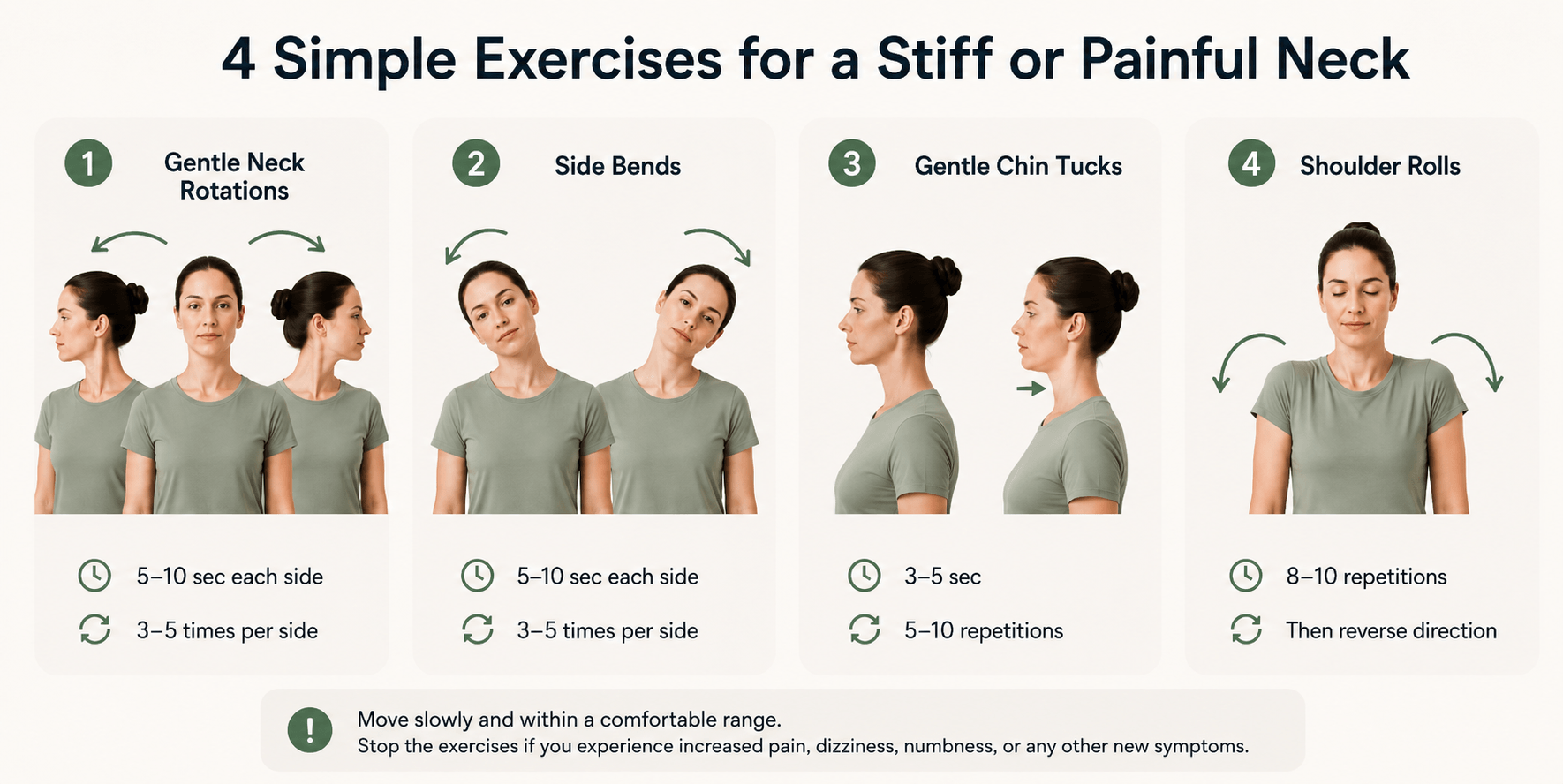
4 simple exercises for a stiff or painful neck
These exercises require no equipment and can be done at home or at work. Move slowly and stay within a comfortable range of motion.
1. Gentle neck rotations
Sit or stand upright with your shoulders relaxed. Slowly turn your head to the right until you feel a gentle stretch. Hold for 5 to 10 seconds, slowly return to the center, and repeat on the left. Do this 3 to 5 times on each side.
Breathe normally throughout the exercise and keep the movement slow and controlled. Avoid jerking your head or turning farther than feels comfortable.
2. Side bends
Keep your shoulders relaxed and gently bring your right ear toward your right shoulder without lifting the shoulder. Hold for 5 to 10 seconds, return to the center, and repeat on the opposite side. Do this 3 to 5 times on each side.
You should feel a gentle stretch along the side of your neck, not a sharp pain. Avoid using your hand to pull or push your head farther into the stretch.
3. Gentle chin tucks
Look straight ahead and keep your head upright. Gently draw your chin straight back without tilting your head up or down. Think of making the back of your neck slightly longer. Hold for 3 to 5 seconds, release, and repeat 5 to 10 times.
Keep the movement small and controlled. Relax your shoulders, breathe normally, and avoid forcing your chin backward.
4. Shoulder rolls
Sit or stand upright. Slowly lift your shoulders, roll them backward, and lower them again in a controlled circular motion. Complete 8 to 10 slow repetitions, then repeat in the opposite direction.
Keep your neck relaxed and move your shoulders at a comfortable pace without any fast or jerky movements. Make the circles smaller if the movement causes discomfort.
You can do these exercises once or twice a day, for example after spending long periods in front of a screen. The key is to keep the movements slow and controlled and stay within a range that feels comfortable.
Stop the exercises if you experience increasing pain, dizziness, numbness, or any other new symptoms.
Modern neck pain relief: Red light therapy
Red light therapy, also known as photobiomodulation, uses specific wavelengths of red and near-infrared light on the body.
The light is absorbed by tissues and may influence biological processes involved in cellular energy production and local circulation. Photobiomodulation has been studied and used in a range of applications related to pain and recovery.
For neck pain, red light therapy is best viewed as a complement to other approaches. It doesn’t replace movement, healthy work habits, or medical evaluation when needed.
FlexBeam is Recharge Health’s portable device for targeted red and near-infrared light therapy. Its flexible design allows the light to be positioned directly over the area you want to target, such as the neck and shoulders.
This makes it easy to incorporate red light therapy into a daily routine that also includes movement, regular breaks, exercises, and recovery.

Want to learn more about how red light therapy is used for pain? Read more about pain relief with red light therapy.
You can also check out our neck placement guide for practical guidance on how to use FlexBeam.
Want to learn more about how near-infrared light affects the body? Read our beginner’s guide to red light therapy.
When should you see a doctor for neck pain?
You should see a doctor if your neck pain is severe or persistent, occurs after a significant injury, or is accompanied by symptoms such as weakness, numbness, fever, or feeling seriously unwell.
Most episodes of neck pain aren’t a sign of a serious medical condition. However, it’s important to pay attention to symptoms that may require further evaluation.
Contact a doctor or other appropriate healthcare professional if you experience:
- Weakness in your arm or hand
- Persistent or worsening numbness
- Neck pain that radiates into your arm and doesn’t go away
- Fever along with significant neck pain or severe neck stiffness
- Neck pain following a serious injury or accident
- Severe pain that gets worse quickly
- New problems with balance or coordination
- Neck pain that doesn’t improve over time or keeps coming back
If you develop sudden, severe symptoms, seek emergency medical care.
In short
Neck pain is common and is often caused by muscle tension, prolonged static positions, stress, or temporary stiffness.
- Move your neck regularly and change positions throughout the day
- Take breaks from screens and prolonged periods in the same position
- Prioritize sleep, physical activity, and recovery
- Try simple, gentle neck exercises if they feel comfortable
- See a healthcare professional for persistent pain or symptoms such as weakness, numbness, or fever
Red light therapy can also be used as a complement to a broader pain management and recovery routine.
Looking for targeted relief for your neck and shoulders at home? Try FlexBeam and discover how it can fit into your daily recovery routine.
Frequently asked questions about neck pain
For mild neck pain, try gentle movement, regular breaks from prolonged static positions, simple exercises, and heat if it feels soothing. Avoid movements that clearly make the pain worse.
If the pain is severe or persistent, contact a healthcare professional.
Neck pain can occur alongside nausea, for example when accompanied by headaches or dizziness. However, nausea can have many causes and shouldn’t automatically be attributed to neck pain.
See a doctor if your pain is severe or persistent, or if you experience weakness, numbness, fever, severe neck stiffness, or persistent pain that radiates into your arm. Neck pain following a significant injury should also be evaluated.
Try to sleep in a position that gives your head and neck good support and keeps them in as natural a position as possible. A pillow that’s too high or too low can leave your neck bent at an uncomfortable angle throughout the night.
Pain, tenderness, stiffness, and reduced range of motion can occur with inflammation, but these symptoms can also have many other causes. If your symptoms are severe or persistent, seek a professional evaluation.
Yes. Stress can increase muscle tension in the neck and shoulders while also affecting sleep and recovery. Over time, this can contribute to both stiffness and pain.